
Last Revised: April 12, 2024
Revision 9/2022
Hazard Description
Some chemicals, when in contact with water, may emit flammable gases that can form explosive mixtures with air. Such mixtures are easily ignited by ordinary sources of ignition, for example sparking tools or light bulbs. The resulting blast wave and flames may be hazardous to people and the environment. Sometimes these chemicals are referred to as water-reactive substances.
The term used for these chemicals by the Globally Harmonized System of Classification and Labeling of Chemicals (GHS) is: Chemicals Which, in Contact with Water, Emit Flammable Gases
The most common water-reactive chemicals include sodium, potassium, lithium metals and aluminum alkyls.
Chemicals with this hazard will include the GHS pictogram for flammability on their label and Safety Data Sheet and will include one of three hazard statements, depending on the severity of the hazard.
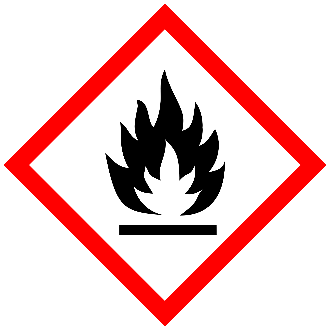
|
H260 |
In contact with water releases flammable gases which may ignite spontaneously |
Category 1 |
Danger |
|
|
H261 |
In contact with water releases flammable gas |
Category 2 |
|
Danger |
|
H261 |
In contact with water releases flammable gas |
Category 3 |
|
Warning |
Some materials can also react vigorously with water to rapidly produce gases which are deadly at low airborne concentrations. For example, sodium or potassium phosphide release phosphine gas when they contact water. Alkali metal cyanide salts, such as sodium or potassium cyanide, slowly release deadly hydrogen cyanide gas on contact with water. The cyanide salts of alkaline earth metals such as calcium or barium cyanide react at a faster rate with water to produce hydrogen cyanide gas. This can result in a life-threatening problem in confined spaces or poorly ventilated areas.
Large amounts of corrosive hydrogen chloride gas are rapidly released when water reacts with aluminum chloride, phosphorous trichloride, tin chloride and chlorosilane compounds. When water contacts thionyl chloride or sulphuryl chloride, they decompose rapidly giving off sulphur dioxide gas and hydrogen chloride gas.
To identify the chemicals with this hazard in your ChemTracker chemical inventory, use the instructions in EHRS Tip Sheet: Completing a Hazard List Analysis.
Approvals
If you or your lab has not worked with this hazard before and you are considering a procedure that requires you to do so, we recommend contacting EHRS for guidance.
All work that involves the handling or transfer of water-reactive chemicals requires the approval of the P.I. The P.I. must ensure that the person or team who will be working with the water-reactive chemicals understands the hazards and has received adequate training and supervision for the procedure.
For any task that requires safety controls beyond those specified in this SOP, a task-specific Hazard Control Plan (HCP) must be written. The HCP must be sent to EHRS for review. EHRS will upload the HCP to the “documents” section of the lab’s BioRAFT page.
Training Requirements
No researcher may work independently with the hazardous material described in this SOP until the Principal Investigator (or their designee) has ensured that the researcher:
- Has completed all required EHRS laboratory safety training programs
- Understands the hazards of the materials and risks of the processes involved
- Has read and understands the contents of this SOP
- Demonstrates the ability to execute their work according to the requirements in this SOP
Facility Requirements
General Ventilation
Water-reactive chemicals may not be handled or stored in a room or facility with recirculating exhaust.
Chemical Fume Hood or Glove Box
All work with water-reactive chemicals in open systems must be done in a designated area of a laboratory inside of a properly functioning chemical fume hood or dry-atmosphere glove box.
Emergency Irrigation
Emergency irrigation (safety shower, eyewash) must be accessible within a 10-second travel distance of the area where the work is performed.
Signage and Labeling
A legible manufacturer’s label including hazard information must be present on all commercial containers of water-reactive chemicals.
If water-reactive chemicals are transferred to another container for storage or to make stock solutions for later use, special labeling requirements apply. See the “Researcher-Created Labels” section in Section IV: Chemical Container Labeling in this CHP for a complete list of requirements.
Storage and Transport
Proper storage and transport of water-reactive chemicals must be determined by assessing all of the hazards and physical properties of the chemical.
See Section VI: Chemical Storage and Transportation in this CHP for a complete list of requirements.
Special Considerations for Storage of Water-Reactive Compounds
- Water-reactive chemicals must not be stored with aqueous (water-containing) solutions, or near other sources of water such as sinks, water baths, or recirculating chillers.
- Do not store water-reactive chemicals with flammable materials or in a flammable-liquids storage cabinet where flammable chemicals are stored.
- Store these materials away from sources of ignition.
- Minimize the quantities of water-reactive chemicals stored in the laboratory.
- Never return excess chemicals to the original container. Small amounts of impurities may be introduced into the container which may cause a fire or explosion.
- Date containers upon initial receipt and upon opening. Take note of any printed expiration dates on the container label and dispose of them as required.
- Examine storage containers frequently. Dispose of any container that begins to show signs of damage.
- Dispose of all water-reactive chemicals whenever they are no longer required for current research.
Hazard Controls
Engineering Controls
Chemical Fume Hood
All work with water-reactive chemicals in open or closed systems that is not performed inside of an inert atmosphere glove box must be done in a designated area of a laboratory inside of a properly functioning chemical fume hood.
Many water-reactive chemicals release noxious or flammable gases. Some solid water-reactive materials are stored under kerosene (or other flammable solvents), therefore the use of a fume hood is required to prevent the release of flammable vapors in the laboratory.
The fume hood is designed to capture chemical vapor and the hood sash acts as a shield in case of chemical splash. The sash must be kept closed as much as feasible.
Blast Shield
Safety shielding is required any time there is a risk of explosion, splash hazard or a highly exothermic reaction. All manipulations of water-reactive chemicals which pose this risk should occur in a fume hood with the sash in the lowest feasible position. A portable blast shield may be placed in front of a vessel containing a highly reactive material. This provides additional protection in the case of a violent reaction. Your lab's task-specific Hazard Control Plan will specify whether a blast shield is required for your process.
Vacuum Protection
Evacuated glassware can implode and eject flying glass and splattered chemicals. Vacuum work involving water-reactive chemicals must be conducted in a fume hood or isolated in an acceptable manner.
Mechanical vacuum pumps must be protected using cold traps and, where appropriate, filtered to prevent particulate release. The exhaust for the pumps must be vented into an exhaust hood. Vacuum pumps should be rated for use with water-reactive chemicals.
For more information about vacuum protection see the CHP Fact Sheet on Vacuum Pumps and CHP SOP on Glassware under Vacuum.
Glove Box
Glove boxes must be used to handle water-reactive chemicals if sufficient dry atmospheres cannot be achieved using a vacuum/gas manifold and other techniques for excluding moisture. The Office of Environmental Health and Radiation Safety (8-4453) or the Principal Investigator will determine if this is required.
Work Practices
A list of recommended work practices for hazardous chemical handling is included in Section V: Chemical Handling in this CHP. Of particular relevance to water-reactive chemical use:
Considerations for purchase
- Do not use water-reactive chemicals if less-hazardous alternatives are possible.
- Purchase water-reactive reagents in the minimum quantity required for the work to be performed. Initial cost per volume/weight may be lower when reagents are purchased in bulk, but repeated opening of containers and puncturing of septa leads to product degradation and loss. Wasted material and disposal cost will often offset any initial savings.
- Purchase the lowest concentration of water-reactive chemicals that will meet your research needs.
Considerations for work space
- Work with water-reactive chemicals in areas that you've designated especially for this work.
- Post a sign on the fume hood when a process involving water-reactive chemicals is unattended. A template is available for download: Unattended Operations Sign Template
- Remove all other chemicals and hazardous materials from the work area.
- Remove combustible and flammable materials from the work area.
- Remove sources of ignition and heat from the work area.
Considerations for handling
- Do not handle water-reactive chemicals when working alone.
- Notify other lab occupants when you work with water-reactive chemicals is in progress.
- Immediately close all containers of water-reactive chemicals after use and return them to their designated storage location.
Additional work practices for reducing the risks of any lab procedure involving water-reactive chemicals must be described in a written Hazard Control Plan.
Personal Protective Equipment
Consider the potential routes of exposure and health consequences when selecting personal protective equipment (PPE) for tasks involving water-reactive chemicals.
In addition to the minimum lab apparel and PPE requirements, other protective equipment may be necessary to reduce risks. When additional equipment (such as tight-fitting chemical splash goggles, chemical-resistant gloves, or disposable lab coats) are required, a Hazard Control Plan must be written to document the risk assessment and controls.
Unless work will be performed in a glove box, it is highly recommended that a fire-resistant lab coat be worn while manipulating quantities of water-reactive liquid over 10 mL or solids over 1 gram. Contact EHRS before ordering fire-resistant lab coats, as some garments offer better protection than others. There are often strict requirements for laundering in order to maintain the fire-resistant properties of the garments. EHRS will recommend the right product for your lab's needs.
Disposable nitrile gloves provide adequate protection against accidental hand contact with small quantities of most laboratory chemicals, but are highly combustible. Consider the use of Nomex/Leather pilot’s gloves, which provide fire resistance without compromising manual dexterity. The pilots gloves should be worn over nitrile gloves and are recommended during syringe/cannula transfers of pyrophoric liquids.
Contact EHRS for general assistance with risk assessments, glove compatibility, and other PPE selection.
The minimum PPE requirements for all chemical handling tasks, and information about specialty PPE can be found in the "Personal Protective Equipment" section of Section V: Chemical Handling in this CHP.
Waste and Decontamination
For complete hazardous waste guidelines, see the waste section of the EHRS website: Laboratory Chemical Waste Management Guidelines
Some general guidance is given below.
- Wash hands thoroughly with soap and water after handling any chemical and whenever you leave the lab.
- Use good housekeeping practices to avoid contamination of surfaces, garments, personal belongings, and self.
- Decontaminate all surfaces that have come in contact with water-reactive chemicals and clean-up small spills promptly. See the chemical Safety Data Sheet or contact EHRS for assistance with determining an appropriate decontamination method. See “Spills” below for instruction on what to do in the event of a large or hazardous spill of a water-reactive chemical.
Waste Collection and Disposal
See the page Disposal of Highly Reactive Reagents for guidance on how to dispose of unused or expired highly reactive chemicals.
|
If you find a water-reactive chemical container that is damaged, bulging, past-expiration, leaking or otherwise compromised in any way, do not handle the container. Move away from the area and prevent others from entering the area. Contact EHRS immediately by calling 215-898-4453. |
Emergencies
Emergency Contacts
General emergency response information can be found at Emergency Info
Spills
Anticipate spills by having the appropriate clean-up equipment on hand. The appropriate clean-up supplies can be determined by consulting the safety data sheet or will be included in your lab's task-specific Hazard Control Plan. Spill control materials for water-reactive chemicals are designed to be inert and will not react with the reagent.
Planning for spills must occur prior to the use of any water-reactive chemicals.
General procedures for chemicals spill response can be found in Section X: Chemical Spills in this CHP.
Do not hesitate to call EHRS for assistance with spill cleanup for water-reactive materials.
24 hours: 215-898-4453
Contact Penn Police (511) only if the spill involves a fire, imminent risk of fire, an injury requiring an ambulance, or if there is a hazard that may affect others in the building.
List of Water-Reactive Chemicals
This list includes common examples of water-reactive chemicals found in research laboratories. This is not a comprehensive list. See the SDS for each chemical to identify its hazards.
Alkali Metals
- Lithium
- Sodium
- Cesium
- Potasium
Alkaline Earth Metals
- Magnesium
- Barium
- Calcium
Metal Hydrides
- Lithium aluminum hydride (LAH)
- Calcium hydride
- Potassium hydride
Alkyl and Aryl Magnesium Halides
- "Grignard reagents" (e.g. methylmagnesium bromide, ethylmagnesium chloride)
References
This SOP was based on the previous version of “EHRS SOP for Water-Reactive Chemicals” and the following additional resources:
- https://www.osha.gov/Publications/OSHA3844.pdf