
Last Revised: April 12, 2024
Revised 9/2022
This SOP primarly describes the hazards, restrictions, and controls for Flammable Liquids. Information about flammable solids can be found in SOP: Reactive Chemicals and flammable gases are described in SOP: Hazardous and Highly Toxic Gases.
Hazard Description
The flashpoint of a flammable liquid is the lowest temperature at which it can form an ignitable mixture with air and produce a flame when a source of ignition is present.
Flammable liquids are chemicals that have a flash point below 100oF (38.7o C) and a vapor pressure that does not exceed 40 psig at 100oF.
Flammable liquids are commonly divided into three classes
|
Class |
Flash Point |
Boiling Point |
Example |
|
IA |
Below 73°F |
Below 100 °F |
Ethyl Ether |
|
IB |
Below 73 °F |
At or above 100 °F |
Acetone, Benzene, Toluene |
|
IC |
At or above 73 °F and below 100 °F |
|
Hydrazine and Styrene |
Combustible liquids are divided into three classes
|
Class |
Flash Point |
Example |
|
II |
100-139 °F |
Acetic acid, naptha and stoddard solvent |
|
IIIA |
140-199 °F |
Cyclohexanol, formic acid and nitrobenzene |
|
IIIB |
200 °F or above |
Formalin and picric acid |
Static Electricity Hazards in the Laboratory
The flow of flammable and combustible liquids can cause the buildup of static electricity. When enough of a charge is built up a spark can result and potentially cause a fire or explosion. The likelihood of this happening is dependent upon how well the liquid conducts electricity, the flash point and the capacity to generate static electricity.
Static electricity can be generated when liquid is transferred from one metal container to another. Liquids have the ability to generate static electricity when they move in contact with other materials during pouring, pumping or agitating. The build up of this static electricity can cause a spark to form where the solvent exits the container. This could result in a fire or explosion.
See the Hazard Controls section below for more information about preventing static electricity ignition when handling flammable liquids.
Approvals
Purchase of any container of flammable liquids with a volume of greater than 5 gallons requires EHRS approval.
If you or your lab has not worked with this hazard before and you are considering a procedure that requires you to do so, we recommend contacting EHRS for guidance.
All work that involves the handling or transfer of flammable chemicals requires the approval of the P.I. The P.I. must ensure that the person or team who will be working with the flammable chemicals understands the hazards and has received adequate training and supervision for the procedure.
For any task that requires safety controls beyond those specified in this SOP, a task-specific Hazard Control Plan (HCP) must be written. The HCP must be sent to EHRS for review. EHRS will upload the HCP to the “documents” section of the lab’s BioRAFT page.
Training Requirements
No researcher may work independently with the hazardous material described in this SOP until the Principal Investigator (or their designee) has ensured that the researcher:
- Has completed all required EHRS laboratory safety training programs
- Understands the hazards of the materials and risks of the processes involved
- Has read and understands the contents of this SOP
- Demonstrates the ability to execute their work according to the requirements in this SOP
Facility Requirements
General Ventilation
Flammable chemicals may not be handled or stored in a room or facility with recirculating exhaust.
Chemical Fume Hood
All work with flammable chemicals in open systems must be done in a designated area of a laboratory inside of a properly functioning chemical fume hood. Closed systems outside of the fume hood must be vented to a dedicated exhaust that does not recirculate.
In some cases, small quantities of flammable liquids with low toxicity (by inhalation) may be handled outside of a chemical fume hood. Contact EHRS to request a risk assessment to determine whether this can be permitted for a specific chemical and task.
Emergency Irrigation
Emergency irrigation (safety shower, eyewash) must be accessible within a 10-second travel distance of the area where the work is performed.
Signage and Labeling
A legible manufacturer’s label including hazard information must be present on all commercial containers of flammable chemicals.
If flammable chemicals are transferred to another container for storage or to make stock solutions for later use, special labeling requirements apply. See the “Researcher-Created Labels” section in Section IV: Chemical Container Labeling in this CHP for a complete list of requirements.
Flammable liquids storage cabinets and refrigerators approved for flammable storage must be labeled with the words “Flammable-Keep Fire Away”.
Storage and Transport
Proper storage and transport of Flammable Chemicals must be determined by assessing all of the hazards and physical properties of the chemical.
See Section VI: Chemical Storage and Transportation in this CHP for a complete list of requirements.
Flammable Liquids Storage Cabinets (FLSCs)
FLSCs are constructed to limit the internal temperature when exposed to fire. In order to perform this function, the cabinet must be in good condition. No penetrations may be made through the cabinet wall, and all bungs must be plugged or appropriately connected to exhaust. The door to the cabinet must also be closed and latched using the original manufacturer hardware. Doors that do not close and latch must be repaired or the cabinet must be replaced.
An acceptable FLSC:
- Meets the construction requirements of NFPA 30-4.3.3
- or is custom-built and tested in accordance with section NFPA 30-4.3.3(a)
- or meets the requirements of UL 1275
If you are unsure whether your storage location and cabinet are acceptable, contact EHRS for guidance.
General Guidance
- One or more Flammable Liquid Storage Cabinets (FLSC) are required for laboratories which store, use or handle more than 5 gallons of flammable or combustible liquids.
- The storage of flammable and combustible liquids in a laboratory, shop, or building area must be kept to the minimum needed for research and/or operations.
- FLSC are not intended for the storage of highly toxic materials, acids, bases, compressed gases or pyrophoric chemicals.
- FLSCs must be clearly marked “Flammable Storage” or "Flammable - Keep Fire away"
- All containers of flammable liquids must be stored in a FLSC when not in use. The following requirements apply:
- Flammable liquids storage cabinets are equipped with a grounding system that can be connected to a building ground. If you are pouring from a container in the storage cabinet and if the container being poured to is conductive then a bonding strap should be attached between them as explained in ‘PROCEDURES TO AVOID STATIC ELECTRICITY’ found in the “Transferring” section of this SOP.
- In ChemTracker, the “Bench” location field is required for Flammable Liquids Storage Cabinets (FLSCs) in the high-rise biomedical buildings.
Contact EHRS regarding the venting of FLSCs to exhaust ducts if you believe this is needed in your lab.
Additional information can be found in Lab Design and Equipment: Flammable Liquids Storage Cabinets Specification and What is a Flammable Liquids Storage Cabinet?
Hazard Controls
Engineering Controls
Chemical Fume Hood
All work with flammable chemicals in open systems must be done in a designated area of a laboratory inside of a properly functioning chemical fume hood. Closed systems outside of the fume hood must be vented to a dedicated exhaust that does not recirculate.
The fume hood is designed to capture chemical vapor and the hood sash acts as a shield in case of chemical splash. The sash must be kept closed as much as feasible.
In some cases, small quantities of flammable liquids with low toxicity (by inhalation) may be handled outside of a chemical fume hood. Contact EHRS to request a risk assessment to determine whether this can be permitted for a specific chemical and task.
Safety Shielding
Shielding is required any time there is a risk of explosion, splash hazard or a highly exothermic reaction. All manipulations of flammable liquids which pose this risk should occur in a fume hood with the sash in the lowest feasible position. Portable shields, which provide protection to all laboratory occupants, are acceptable.
Vacuum Protection
Mechanical vacuum pumps must be protected using cold traps and, where appropriate, must include a filter to prevent particulate release. The pump exhaust must be vented into an approved exhaust duct or chemical fume hood.
Equipment to Avoid Static Electricity Discharge
To avoid the buildup of static electricity that may cause a spark, it is important to bond and ground metal or special conductive plastic containers. Bonding eliminates the electrical potential between two containers therefore eliminating the likelihood of sparks. A bonding wire is connected to two conductive objects as seen in the drums pictured below.
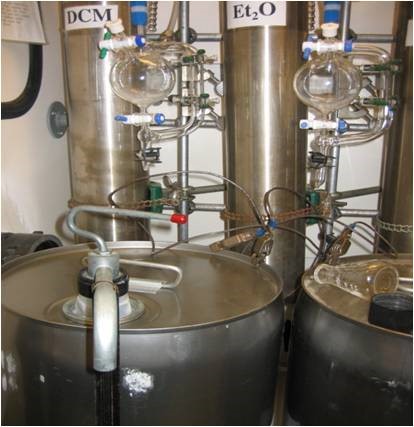
Grounding eliminates the difference in static potential charge between the conductive object and ground. Grounding is accomplished by connecting the conductive object directly to the earth, usually using cold water copper pipes, building steel or grounding bus/bar.
Bonding and grounding require good electrical connections. Remove any dirt, paint or rust ensuring metal to metal contact.
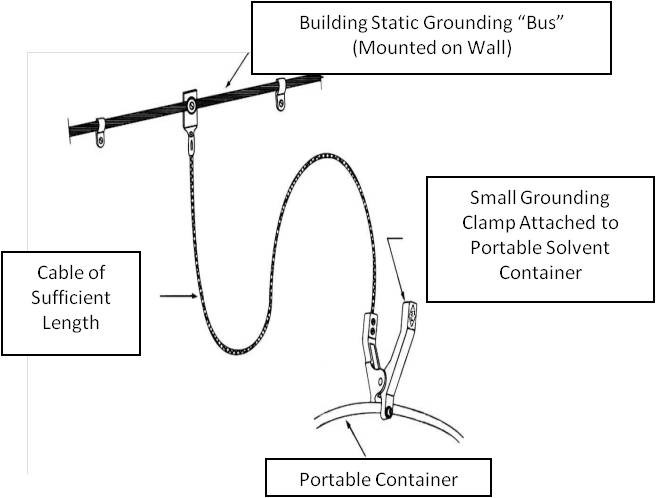
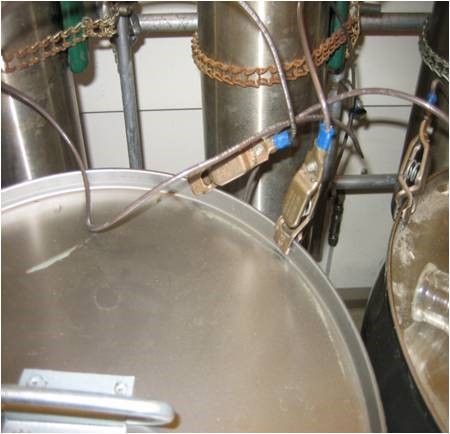
Bonding and Grounding wires come in a variety of styles and lengths. They can be purchased through Fisher Scientific, Justrite Manufacturing and Grainger.


Static hazards may also exist in non-metallic plastic or glass containers that cannot be grounded. Static may be generated by the free fall and turbulence of the liquid being poured. To minimize this hazard, pour as slowly as possible and use a grounded nozzle extension that allows filling the container from the bottom.
Dispensing pumps for 5-gallon Solvent Cans
Manual dispensing pumps for 5-gallon cans are available. These pumps are specifically designed to dispense liquids into small laboratory-size bottles without spilling. If you are pouring into a conductive container, a bonding wire should be attached from the 5-gallon pail to the container being filled. The 5-gallon can must be grounded.
The dispenser shown in the picture below can be purchased through Fisher Scientific. The metal strap in the picture hooks over the bottom of the pail and secures the dispenser while pumping.
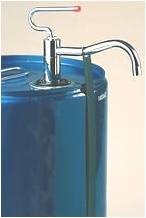
Two adapters are provided with the dispensing pump from Fisher (grey and black). Use the appropriate adapter to achieve the correct seal with the solvent container you have. Some solvent containers have a grey fitting at the opening, and others have the black one.
Dispensing from Safety Cans
Safety cans have self-closing air tight lids and a flame arrester that protects the contents from an external ignition source. Bonding and grounding is still required on safety cans since static electricity generation is possible. The nozzle provides a bonding path to a receiving metallic vessel.
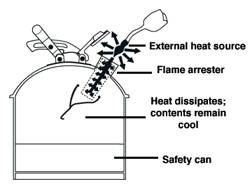
If either of the containers are non-metallic (conductive) it is still important to follow the limited velocity and grounded nozzle extension information given previously.
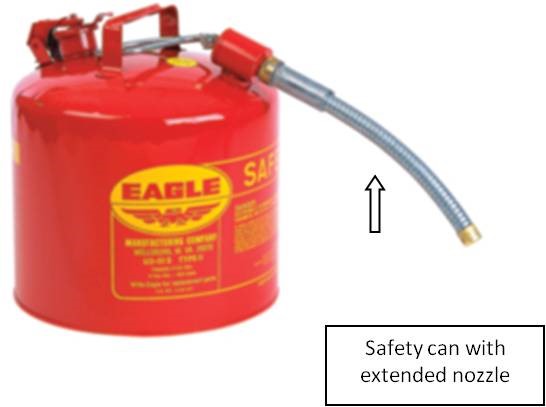
Safety cans do not offer protection from heat when exposed to fire and should be stored in a flammable liquids storage cabinet when not in use.
Work Practices
A list of recommended work practices for hazardous chemical handling is included in Section V: Chemical Handling in this CHP. Of particular relevance to flammable chemical use:
Considerations for purchase
- Do not use flammable chemicals if less-hazardous alternatives are possible.
- Purchase, dispense, and use the smallest quantity of flammable chemicals possible. (Purchase of containers of flammable liquids greater than 5 gallons require EHRS approval.)
- Purchase the lowest concentration of flammable chemicals that will meet your research needs.
- Do not purchase flammable chemicals unless you have an appropriate storage location for them. For example: Do not buy more flammable liquids if your flammable liquids storage cabinet is too full to store them.
Considerations for work space
- Remove all flammable and combustible materials from the fume hood or work space when they are not needed for the immediate task.
- Do not store flammable liquids in chemical fume hoods or allow containers of flammable liquids in proximity to heating mantles, hot plates, or torches.
Considerations for handling
- Do not handle flammable chemicals when working alone.
- Immediately close all containers of flammable chemicals after use.
- Due to the risk of splashes and equipment failures, do not use a syringe and needle to perform transfers of flammable chemicals in volumes of greater than 5 mL.
Heating and Open Flame
- Laboratory ovens must be vented to a dedicated laboratory exhaust to reduce the hazard of accumulating an explosive mixture of flammable vapor within the oven.
- Drying ovens should not be used to dry glassware that has been rinsed with organic solvents until the majority of the solvent has had the opportunity to drain or evaporate at room temperature.
- Do not use mercury thermometers to monitor oven temperatures. Accidental breakage of the thermometer will cause a serious hazard since un-contained mercury will volatilize very rapidly. (For more information see Fact Sheet: Mercury)
Additional work practices for reducing the risks of any lab procedure involving flammable chemicals must be described in a written Hazard Control Plan.
Personal Protective Equipment
Consider the potential routes of exposure and health consequences when selecting personal protective equipment (PPE) for tasks involving flammable chemicals.
In addition to the minimum lab apparel and PPE requirements, other protective equipment may be necessary to reduce risks. When additional equipment (such as tight-fitting chemical splash goggles, chemical-resistant gloves, or disposable lab coats) are required, a Hazard Control Plan must be written to document the risk assessment and controls.
In labs where there is a high risk of fire, such as those that use large volumes of highly flammable liquids, open flame, and/or pyrophoric materials, a fire-resistant lab coat or other fire-resistant PPE may be required.
Contact EHRS for assistance with risk assessments, glove compatibility, and other PPE selection.
The minimum PPE requirements for all chemical handling tasks, and information about specialty PPE can be found in the "Personal Protective Equipment" section of Section V: Chemical Handling in this CHP.
Waste and Decontamination
Wash hands thoroughly with soap and water after handling any chemical and whenever you leave the lab.
Use good housekeeping practices to avoid contamination of surfaces, garments, personal belongings, and self.
Decontaminate all surfaces that have come in contact with flammable chemicals and clean-up small spills promptly. See the chemical Safety Data Sheet or contact EHRS for assistance with determining an appropriate decontamination method. See “Spills” below for instruction on what to do in the event of a large or hazardous spill of an flammable chemical.
For complete hazardous waste guidelines, see the waste section of the EHRS website: Laboratory Chemical Waste Management Guidelines
Emergencies
Emergency Contacts
General emergency response information can be found at Emergency Info
Spills
General procedures for chemicals spill response can be found in Section X: Chemical Spills in this CHP.
Do not hesitate to call EHRS for assistance with spill cleanup for flammable materials.
24 hours: 215-898-4453
Contact Penn Police (511) only if the spill involves a fire, imminent risk of fire, an injury requiring an ambulance, or if there is a hazard that may affect others in the building.
Related SOPs and Fact Sheets
Chemical Hygiene Plan
Section VI: Chemical Storage and Transportation
Lab Design and Equipment
Flammable Liquids Storage Cabinets Specification
SOPs and Fact Sheets
References
This SOP was based on the previous version of “EHRS SOP for Flammables” and the following additional resources:
1. NFPA 30