
Last Revised: April 12, 2024
The requirements in Penn's Chemical Hygiene Plan SOP: Reproductive Health Hazards apply to all work involving ethidium bromide. The Fact Sheet below gives hazard information and precautions for working with ethidium bromide; however, this information is provided as a supplement to the SOP, which must first be read and understood by anyone planning to work with this chemical.
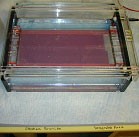
Ethidium bromide, (Dromilac, homidium bromide), CAS # 1239-45-8, is commonly used in molecular biology laboratories for visualizing nucleic acids using electrophoresis and other gel-based nucleic acid separation methods. Ethidium bromide fluoresces when exposed to ultraviolet light and exhibits a vivid red-orange color when bound to nucleic acids.
Hazard Description
Ethidium bromide is a potent mutagen and is an irritant to the eyes, skin and respiratory tract. Ethidium bromide can be absorbed through exposed skin and mucus membranes.
Personal Protective Equipment
See the personal protective equipment requirements in SOP: Reproductive Health Hazards.
Special Work Practices
Locations where ethidium bromide is used or stored must be identified as "Designated Areas" and demarcated with either printed Designated Area tape available from EHRS or yellow tape with "DESIGNATED AREA" written upon it. Preprinted tape is available from EHRS. Alternately the lab worker may write “designated area” on yellow tape.
Procedures requiring the use of ethidium bromide powder or having the potential to generate aerosols must be performed in a fume hood. To minimize inhalation exposure, purchase ready-made stock solutions or tablets in lieu of preparing stock solutions from ethidium bromide powder.
During normal use, small spills may occur and residues may build up on equipment and other laboratory surfaces. A solution of soap and water is recommended for cleaning small spills and removing residues on equipment and laboratory surfaces.
Due to the potential for equipment contamination, ethidium bromide-containing agarose gel should not be heated in a microwave.
Since ethidium bromide is used in conjunction with an ultraviolet light source, please review the Ultraviolet Radiation Safety Fact Sheet.
Ethidium Bromide Waste Disposal
Ethidium Bromide waste in concentrated or solid form is collected as hazardous waste and should not be flushed down the drain or disposed of in the trash. Please review the Ethidium Bromide Waste Disposal Policy for additional information. Waste should properly labeled and handled as follows:
Write the date received and the date opened on all containers of ether. Discard open containers of ether within six months of opening.
Liquids
Small quantities of aqueous solutions containing an ethidium bromide concentration of less than 10 µg/ml (10 ppm) may be flushed down the drain. Non-aqueous solutions and solutions containing an ethidium bromide concentration of greater than 10 µg/ml will be picked up by EHRS. EHRS provides 19-liter polyethylene carboys for large volume liquid waste collection. Laboratories are responsible for providing small volume waste containers.
Contaminated sharps (needles, syringes, slides, broken glass, etc.)
Discard in an infectious waste sharps container clearly labeled "CHEMICAL CONTAMINATED SHARPS-DO NOT AUTOCLAVE". Discard the sharps container as infectious waste without autoclaving when it is 2/3 to 3/4 full.
Solids (contaminated gloves, centrifuge tubes, towels, etc.)
Store in an a properly labeled translucent polyethylene container for disposal as chemical waste. Do not use glass containers.
Gels
Low concentration gels (< 10 µg/ml) may be wrapped in plastic wrap and discarded in the trash. Higher concentration gels should be disposed of as contaminated solids described above.
Gels containing nucleotide sequences capable of being taken up by microorganisms and expressed (e.g., bacterial plasmids, lentiviral vector plasmids, etc.) must be collected and disposed of as indicated above for solids. Amplified PCR products generally do not fall under this category.
Spill Procedures
General procedures for chemicals spill response can be found in Section X: Chemical Spills in this CHP.
Do not hesitate to call EHRS for assistance with spill cleanup for Acutely Toxic Materials
24 hours: 215-898-4453
Contact Penn Police (511) only if the spill involves a fire, imminent risk of fire, an injury requiring an ambulance, or if there is a hazard that may affect others in the building.
Small spills of ethidium bromide solutions should be cleaned by laboratory staff. For large spills outside the fume hood, evacuate/restrict access to the laboratory and contact EHRS for assistance.
Individuals cleaning spills must wear appropriate protective equipment as described in the Personal Protective Equipment section of this document.
Spills of ethidium bromide solutions should be cleaned using absorbent pads followed by surface decontamination using soap and water. Spilled dry material should first be covered with moist absorbent pads to avoid generation of dust.
Ensure all materials contaminated as a result of the cleanup process are collected and disposed of as hazardous waste as described in the Ethidium Bromide Waste Disposal section of this document.
Additional EHRS Services
Health Hazard evaluations
EHRS is available to review laboratory work practices/procedures and make recommendations to promote the safe use of ethidium bromide in the laboratory.
Emergency Contacts
General emergency response information can be found at Emergency Info