
Last Revised: October 04, 2022
Revised 7/2022
Hazard Description
Corrosive chemicals are substances that cause visible destruction or permanent changes in human skin tissue at the site of contact, or are highly corrosive to steel. Corrosive chemicals can be liquids, solids, or gases and can affect the eyes, skin, and respiratory tract. The major classes of corrosives include strong acids, bases, and dehydrating agents. Liquid corrosive chemicals are those with a pH of 4.0 or lower or a pH of 9 or higher. Solid chemicals are considered corrosive when in solution; they fall in the above pH range. A highly corrosive chemical has a pH of 2 or lower or a pH of 12.5 or higher. Injurious chemicals cause tissue destruction at the site of contact.
Alkali injuries to the eyes are more common than injury from an acid and can be more clinically challenging, with a significant potential for long-term morbidity.
Some examples of corrosive materials:
Strong Acids: hydrochloric, sulfuric, phosphoric
Strong Bases: hydroxides of sodium, potassium, ammonia
Strong Dehydrating Corrosives: sulfuric, phosphophrous pentoxide, calcium oxide
Strong Oxidizing Corrosives: concentrated hydrogen peroxide, sodium hypochlorite
Corrosive Solids: phosphorous, phenol
Corrosive Gases: chlorine, ammonia
Corrosive gases can burn and destroy body tissue (especially the eyes and respiratory tract) on contact. The specific hazards and handling precautions for corrosive gases are detailed in the Chemical Hygiene Plan SOP Hazardous and Highly Toxic Gases. Corrosive gas handling is not in the scope of this SOP on corrosive chemicals.
To identify the chemicals with this hazard in your ChemTracker chemical inventory, use the instructions in EHRS Tip Sheet: Completing a Hazard List Analysis.
Approvals
If you or your lab has not worked with this hazard before and you are considering a procedure that requires you to do so, we recommend contacting EHRS for guidance.
- Notify EHRS before purchasing hydrofluoric acid for use in your laboratory for the first time. See the Hydrofluoric Acid Safety Fact sheet for more details about working with liquid hydrofluoric acid.
- Notify EHRS before purchasing corrosive compressed gases such as anhydrous ammonia or anhydrous hydrogen fluoride.
- Purchase of any container of corrosives with a volume of greater than 5 gallons for laboratory use requires EHRS approval.
All work that involves the handling or transfer of corrosive chemicals requires the approval of the P.I. The P.I. must ensure that the person or team who will be working with the corrosive chemicals understands the hazards and has received adequate training and supervision for the procedure.
For any task that requires safety controls beyond those specified in this SOP, a task-specific Hazard Control Plan (HCP) must be written. The HCP must be sent to EHRS for review. EHRS will upload the HCP to the “documents” section of the lab’s BioRAFT page.
Training Requirements
No researcher may work independently with the hazardous material described in this SOP until the Principal Investigator (or their designee) has ensured that the researcher:
- Has completed all required EHRS laboratory safety training programs
- Understands the hazards of the materials and risks of the processes involved
- Has read and understands the contents of this SOP
- Demonstrates the ability to execute their work according to the requirements in this SOP
Facility Requirements
General Ventilation
Corrosive chemicals may not be handled or stored in a room or facility with recirculating exhaust.
Chemical Fume Hood
All work with corrosive chemicals in open or closed systems must be done in a designated area of a laboratory inside of a properly functioning chemical fume hood.
Emergency Irrigation
Emergency irrigation (safety shower, eyewash) must be accessible within a 10-second travel distance of the area where the work is performed.
Signage and Labeling
A legible manufacturer’s label including hazard information must be present on all commercial containers of corrosive chemicals.
If corrosive chemicals are transferred to another container for storage or to make stock solutions for later use, special labeling requirements apply. See the “Researcher-Created Labels” section in Section IV: Chemical Container Labeling in this CHP for a complete list of requirements.
Storage and Transport
Proper storage and transport of Corrosive Chemicals must be determined by assessing all of the hazards and physical properties of the chemical.
See Section VI: Chemical Storage and Transportation in this CHP for a complete list of requirements.
Specially designed corrosion-resistant cabinets should be used for the storage of corrosive materials. For new lab construction, renovations, and whenever possible in existing labs, the specifications for corrosive cabinets found in the Laboratory Design & Equipment section of the EHRS website should be followed.
If no corrosion-resistant cabinet is available, store corrosives on plastic trays.
Do not store corrosive liquids above eye level.
Expiration of corrosive chemicals
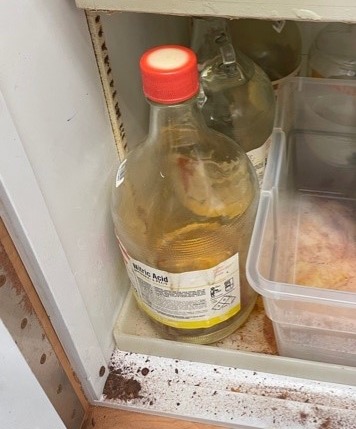
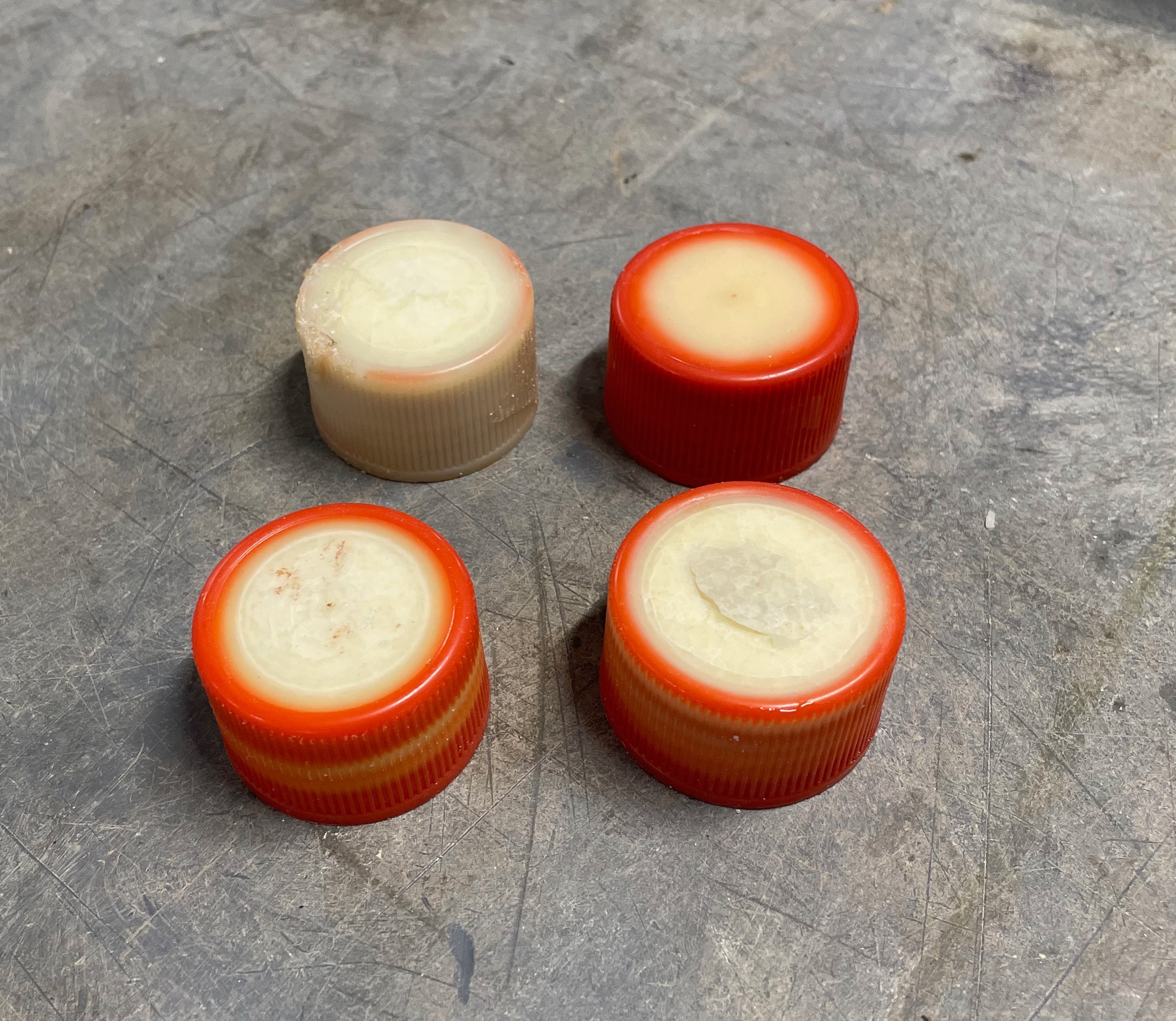
After prolonged storage, containers of concentrated acids such as nitric acid >50% will start to degrade. This is especially true for the plastic caps provided with glass bottles and for containers made of plastic. Damaged containers may result in spills, injury, and/or damage to storage cabinets.
All containers of concentrated, strongly oxidizing acids such as nitric and chromic acid must be labeled with the date received and an expiration date. If there is no expiration date printed on the label, a 2-year expiration should be used for plastic bottles, and a 5-year expiration for glass bottles. Dispose of the expired material as chemical waste through EHRS.
Any container that shows signs of damage, including cracks, leaks, distortion, ill-fitting caps, or discolored bottle or caps must also be disposed of as chemical waste through EHRS. Do not move a container that appears to be compromised. When placing the waste pick-up request, include a comment on the form with a detailed description of the location and condition of the bottle.
If you notice discoloration of a cap before the container expiration date, contact the chemical manufacturer to provide the lot number and request a replacement cap. Only a cap from the manufacturer may be used as a replacement.
Hazard Controls
Engineering Controls
Chemical Fume Hood
Whenever feasible, work with corrosive chemicals in open or closed systems must be done in a designated area of a laboratory inside of a properly functioning chemical fume hood. Work with some concentrated and highly toxic corrosive chemicals must always be performed in a chemical fume hood. Contact EHRS if you are unsure of the ventilation requirements for your procedure.
The fume hood is designed to capture chemical vapor and the hood sash acts as a shield in case of chemical splash. The sash must be kept closed as much as feasible.
Vacuum Protection
Mechanical vacuum pumps must be protected using cold traps and, where appropriate, must include a filter to prevent particulate release. The pump exhaust must be vented into an approved exhaust duct or chemical fume hood.
Work Practices
A list of recommended work practices for hazardous chemical handling is included in Section V: Chemical Handling in this CHP. Of particular relevance to corrosive chemical use:
Considerations for purchase
- Do not use corrosive chemicals if less-hazardous alternatives are possible.
- Purchase, dispense, and use the smallest quantity of corrosive chemicals possible.
- Purchase the lowest concentration of corrosive chemicals that will meet your research needs.
Considerations for work space
- Do not store corrosive chemicals in chemical fume hoods or allow containers of corrosives to come in contact with heating mantles, hot plates, or torches.
Considerations for handling
- Do not handle corrosive chemicals when working alone.
- Immediately close all containers of corrosive chemicals after use.
- Due to the risk of splashes and equipment failures, do not use a syringe and needle to perform transfers of corrosive chemicals in volumes of greater than 5 mL.
- When performing small-volume liquid transfers of highly corrosive materials, it is not appropriate to use a luer-slip syringe type, because the needle can easily detach from the syringe barrel. Luer-lock or integrated-needle syringes must be used with these chemicals.
- Perform liquid transfers slowly using a funnel to minimize slash, splatter, and spills.
- Do not pour water into acid. Slowly add acid to water while carefully stirring. Some corrosive chemicals will generate heat and/or release gas on contact with water. Understand the potential for reaction with water before diluting a chemical. The water may need to be cooled with continuous stirring while acid is added.
- Reactions involving corrosive chemicals are often very exothermic. Use heat-resistant labware and allow extra volume in your vessel to account for expansion and/or foaming. It may be necessary to pre-cool solutions and cool while mixing or reacting.
Additional work practices for reducing the risks of any lab procedure involving corrosive chemicals must be described in a written Hazard Control Plan.
Personal Protective Equipment
Consider the potential routes of exposure and health consequences when selecting personal protective equipment (PPE) for tasks involving corrosive chemicals.
The minimum PPE requirements for all chemical handling tasks, and information about specialty PPE can be found in the "Personal Protective Equipment" section of Section V: Chemical Handling in this CHP.
In addition to the minimum lab apparel and PPE requirements, other protective equipment may be necessary to reduce risks. When additional equipment (such as tight-fitting chemical splash goggles, chemical-resistant gloves, or disposable lab coats) are required, a Hazard Control Plan must be written to document the risk assessment and controls.
An example of a task that would require additional eye/face protection:
- Transfers of corrosive liquids outside of the fume hood.
- Due to the increased risk of splash to the face and eyes when there is no hood sash to shield the worker, tight-fitting chemical-splash goggles and a face shield are required.
Examples of a tasks that require specialty gloves:
- When prolonged contact or immersion of hands in corrosive liquid is anticipated
- When large volumes of corrosive liquids are being transferred
- Handling particularly toxic corrosive chemicals such as hydrofluoric acid.
Contact EHRS for assistance with risk assessments, glove compatibility, and other PPE selection.
Wash hands thoroughly with soap and water after handling any chemical and whenever you leave the lab.
Use good housekeeping practices to avoid contamination of surfaces, garments, personal belongings, and self.
Decontaminate all surfaces that have come in contact with corrosive chemicals and clean-up small spills promptly. See the chemical Safety Data Sheet or contact EHRS for assistance with determining an appropriate decontamination method. See “Spills” below for instruction on what to do in the event of a large or hazardous spill of an corrosive chemical.
Corrosive chemicals are hazardous wastes.
Waste streams that include a mixture of corrosive liquids and peroxides (such as Piranha etch, Chromerge, and Nochromex) produce gas and require special waste procedures. See the CHP Fact Sheet: Gas-Producing Waste for more information.
For complete hazardous waste guidelines, see the waste section of the EHRS website: Laboratory Chemical Waste Management Guidelines
Emergencies
Emergency Contacts
General emergency response information can be found at Emergency Info
All exposures or suspected exposures to hydrofluoric acid require immediate medical attention.
Spills
General procedures for chemicals spill response can be found in Section X: Chemical Spills in this CHP.
Do not hesitate to call EHRS for assistance with spill cleanup for corrosive materials.
24 hours: 215-898-4453
Contact Penn Police (511) only if the spill involves a fire, imminent risk of fire, an injury requiring an ambulance, or if there is a hazard that may affect others in the building.
References
This SOP was based on the previous version of “EHRS SOP for Corrosive Chemicals” and the following additional resources: