
Last Revised: August 25, 2022
Revision 3/2022
Please see the Fact Sheet: Lecture Bottle Safety for special procedures pertaining to lecture bottle cylinders.
Hazard Description
Additional requirements may apply if the materials is a highly toxic compressed gas. Please refer to the SOP for Hazardous and Highly Toxic Gases if applicable.
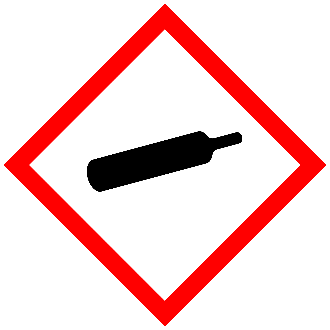
All compressed gases pose a physical hazard because of the high pressures inside the cylinders.
There have been many cases in which damaged cylinders have become uncontrolled rockets or pinwheels and have caused severe injury and damage. This danger has happened when unsecured, uncapped cylinders were knocked over causing the cylinder valve to break and high pressure gas to escape rapidly.
Poorly controlled release of compressed gas in chemical reaction systems can cause vessels to burst, create leaks in equipment or hoses, or produce runaway reactions.
Compressed gases can be either liquefied, non-liquefied, or dissolved.
Depending on the identity of the compressed gas, there may also be additional hazards such as fire, explosion, corrosion, asphyxiation, and toxicity.
Types of Compressed Gas Cylinders
There are three major groups of compressed gases stored in cylinders: liquefied, non-liquefied and dissolved gases. In each case, the pressure of the gas in the cylinder is commonly given in units of kilopascals (kPa) or pounds per square inch gauge (psig).
Gauge pressure = Total gas pressure inside cylinder - atmospheric pressure
Atmospheric pressure is normally about 101.4 kPa (14.7 psi). Note that compressed gas cylinder with a pressure gauge reading of 0 kPa or 0 psig is not really empty. It still contains gas at atmospheric pressure.
Liquefied Gases
Liquefied gases are gases which can become liquids at normal temperatures when they are inside cylinders under pressure. They exist inside the cylinder in a liquid-vapour balance or equilibrium. Initially the cylinder is almost full of liquid, and gas fills the space above the liquid. As gas is removed from the cylinder, enough liquid evaporates to replace it, keeping the pressure in the cylinder constant. Anhydrous ammonia, chlorine, propane, nitrous oxide and carbon dioxide are examples of liquefied gases.
Non-Liquefied Gases
Non-liquefied gases are also known as compressed, pressurized or permanent gases. These gases do not become liquid when they are compressed at normal temperatures, even at very high pressures. Common examples of these are oxygen, nitrogen, helium and argon.
Dissolved Gases
Acetylene is the only common dissolved gas. Acetylene is chemically very unstable. Even at atmospheric pressure, acetylene gas can explode. Nevertheless, acetylene is routinely stored and used safely in cylinders at high pressures (up to 250 psig at 21°C).
This is possible because acetylene cylinders are fully packed with an inert, porous filler. The filler is saturated with acetone or other suitable solvent. When acetylene gas is added to the cylinder, the gas dissolves in the acetone. Acetylene in solution is stable.
Approvals
If you or your lab has not worked with this hazard before and you are considering a procedure that requires you to do so, we recommend contacting EHRS for guidance.
The use of hazardous gases such as flammable, toxic, corrosive, or oxidizing gases requires EHRS review.
All work that involves the use of compressed gas requires the approval of the P.I. The P.I. must ensure that the person or team who will be working with the compressed gas understands the hazards and has received adequate training and supervision for the procedure.
For any task that requires safety controls beyond those specified in this SOP, a task-specific Hazard Control Plan (HCP) must be written. The HCP must be sent to EHRS for review. EHRS will upload the HCP to the “documents” section of the lab’s BioRAFT page.
Facility Requirements
General Ventilation
Gases may not be used or stored in a room or facility with recirculating exhaust.
Chemical Fume Hood or Dedicated Laboratory Exhaust
All work with hazardous gases in open or closed systems must be done in a designated area of a laboratory inside of a properly functioning chemical fume hood or with a dedicated exhaust that does not recirculate within the building.
Emergency Irrigation
Emergency irrigation (safety shower, eyewash) must be accessible within a 10-second travel distance of the area where work with hazardous gas is performed.
Signage and Labeling
Designated area restrictions apply to the use of highly hazardous gases. See the SOP for Hazardous and Highly Toxic Gases for more information.
A legible manufacturer’s label including hazard information must be present on all commercial containers of compressed gas. Container labels may not be removed, altered, or defaced by the user.
Container labels and not color are the primary means of identifying container contents. Many different suppliers use different colors for the same gas.
Compressed gas cylinders must be labeled to indicate whether the cylinder is full or empty.
Compressed gas cylinders stored outside of the laboratory room (e.g. in hallways or equipment corridors) must be labeled to indicate which lab owns the cylinder.
Storage and Transport
Proper storage and transport of compressed gases must be determined by assessing all of the hazards and physical properties of the chemical.
See Section VI: Chemical Storage and Transportation in this CHP for a complete list of requirements.
Cylinders must be stored in areas where they will not become overheated. Avoid storage near radiators, areas in direct sunlight, steam pipes and heat releasing equipment such as sterilizers. Cylinders should not obstruct walkways, exit routes, or other areas normally used or intended for the safe exit of personnel and should not be stored near elevators.
Do not store cylinders or lecture bottles with the regulator in place. If the regulator fails, the entire contents of the gas cylinder may be discharged.
Cylinder caps should remain on the cylinder at all times unless a regulator is in place. Cylinder caps should only be handtight. Do not insert a tool into the cap to loosen it as this can damage the valve assembly or even cause it to fail catastrophically. If the cap is tight, use a cap removal tool or strap wrench, or (carefully) use a pipe wrench. It is responsibility of the labs to purchase a tool if needed. Airgas sells two options that may work for you:
1) Brass, spark free multipurpose wrench that can remove and open gas cylinder valves and is safe for use with flammable gases. The wrench is available with an optional anti-bacterial coating for medical, healthcare, and clinical research settings. Airgas product number for multipurpose wrench: Y99W2000-AG.
2) Cap cylinder and inlet nut wrench similar to what Airgas drivers use for caps and cylinder connections. Airgas product number for cap cylinder and inlet nut wrench: RATATW1027.
For more information, or to receive a price quotation, please reach out to Evaughn Musso of the Penn Inside Support Team at Evaughn.Musso@Airgas.com or 855-636-6316. If the cap is on too tight and cannot be removed with a tool, contact EHRS for guidance.
When the cylinder cap is removed, put it someplace safe as you will need it again. Make sure it is not going to fall on someone/something or create a tripping hazard.
Transport compressed gas cylinders on equipment designed for this function. Never carry or "walk" cylinders by hand.
Securing of gas cylinders
Cylinders of compressed gases must be handled as high energy sources. They pose a serious hazard if the cylinder valve is dislodged. When storing or moving a cylinder, have the cap securely in place to protect the stem. Use suitable racks, straps, chains or stands to support cylinders.
Cylinders shall be stored in an upright position and secured to a wall, floor or laboratory bench through the use of appropriate cylinder supports. When using commercial cylinder supports, do not secure more cylinders than the support was designed for. It is preferable that cylinder supports be purchased from Penn-approved compressed gas or scientific supply vendors. Cylinder supports installed by Penn FRES shall be two sections of unistrut secured to the wall at two and four feet above the floor using fasteners appropriate for the wall construction and weight of cylinders to be secured. Each unistrut shall have a section of chain that securely attaches to the strut at two points. When the chain is attached to the strut it must fit snuggly around the cylinders.
Hazard Controls
Engineering Controls
All components of a system connected to a compressed gas cylinder must be pressure-rated to withstand the maximum pressure capable of being delivered by the cylinder or the maximum output pressure of the regulator that is connected to the cylinder valve.
Safely vent compressed gases to a dedicated fume exhaust. Inert gases may not require dedicated exhaust, but must be exhaust to a well-ventilated area to prevent asphyxiation hazards.
Work Practices
A list of recommended work practices for hazardous chemical handling is included in Section V: Chemical Handling in this CHP. Of particular relevance to compressed gas use:
Considerations for purchase
- Do not use compressed gases if less-hazardous alternatives are possible.
- Purchase, dispense, and use the smallest quantity of compressed gas possible.
- Purchase the lowest concentration of hazardous gases that will meet your research needs.
- Whenever possible, purchase returnable gas cylinders.
Considerations for handling
- Do not handle compressed gases when working alone.
- Immediately close the cylinder valve after use.
- Leak check gas tubing or piping connections before turning on gas by using a solution such as Snoop.
- The use of compressed gas in laboratory animals may require additional work practice controls. Contact EHRS if your protocol involves hazardous gas.
Additional work practices for reducing the risks of any lab procedure involving compressed gases must be described in a written Hazard Control Plan.
Personal Protective Equipment
Consider the potential routes of exposure and health consequences when selecting personal protective equipment (PPE) for tasks involving compressed gases.
In addition to the minimum lab apparel and PPE requirements, other protective equipment may be necessary to reduce risks. When additional equipment (such as tight-fitting chemical splash goggles, chemical-resistant gloves, or disposable lab coats) are required, a Hazard Control Plan must be written to document the risk assessment and controls.
Contact EHRS for assistance with risk assessments, glove compatibility, and other PPE selection.
The minimum PPE requirements for all chemical handling tasks, and information about specialty PPE can be found in the "Personal Protective Equipment" section of Section V: Chemical Handling in this CHP.
Waste and Decontamination
- Wash hands thoroughly with soap and water after handling any chemical and whenever you leave the lab.
- Use good housekeeping practices to avoid contamination of surfaces, garments, personal belongings, and self.
- Whenever possible, contact the gas vendor to return empty cylinders or unneeded quantities of gas in cylinders.
- When it is not possible to return the cylinder or unused gas, contact EHRS for assistance with disposing of cylinders.
For complete hazardous waste guidelines, see the waste section of the EHRS website: Laboratory Chemical Waste Management Guidelines
Emergencies
Emergency Contacts
If you suspect that you may have experienced an exposure to a hazardous gas, seek medical attention immediately.
General emergency response information can be found at Emergency Info
Gas Leaks
If you observe or suspect that hazardous or inert gas is leaking:
- Attempt to turn off the cylinder at the cylinder valve if it is safe to do so
- If you are unable to turn off the gas or have any doubts, evacuate the area and contact EHRS immediately
- Prevent others from entering the area of the suspected gas leak until responders arrive
Do not hesitate to call EHRS for assistance with compressed gas leaks or exposure concerns
24 hours: 215-898-4453
Contact Penn Police (511) only if the leak involves a fire, imminent risk of fire, an injury requiring an ambulance, or if there is a hazard that may affect others in the building.
Related SOPs and Fact Sheets
References
This SOP was based on the previous version of EHRS SOP for Compressed Gases and the following additional resource: